The Orientalist Interior — How to Bring the Souk Home
The souk most of us long for is not a real market in Marrakech or Aleppo. It is a feeling, assembled in the imagination from nineteenth-century paintings, the lamplit pages of the 1001 Nights, and a hundred films that lit a covered market like a cathedral. If you have ever wanted a room to hold a little of that warmth — brass, deep colour, the hush of somewhere older and warmer than where you live — this is a guide to doing it honestly, with a few small objects rather than a costume.
The short version: an orientalist interior is built from aged metal, saturated jewel colour, and low warm light — not from quantity. Three or four objects that catch the light are worth more than a roomful of pattern.
What does an orientalist interior actually look like?
Strip away the cliché and the look comes down to three materials doing quiet work:
- Brass and aged metal — dimmed, darkened, handled. The backbone. It is what the lamplight lands on.
- Jewel-toned enamel and glass — deep red, emerald, cobalt, picked out with gold. Colour that has been sitting in shadow, never bright daylight pastel.
- Pattern, used sparingly — arabesque, calligraphy, a star motif. One strong piece, not every surface.
The mistake people make is reaching for more. The souk feeling is not clutter; it is one warm object glowing in a dim room. Subtract until what is left can breathe.
Light matters as much as objects. Kill the overhead bulb, work in low warm pools of lamplight, and let the metal and enamel do what they were made to do — glint.
Why is brass the backbone of souk-style decor?
Because brass is the material that ages toward beauty. Polished bright it looks like a hardware shop; left to dim and darken with handling, it becomes the warm, shadowed gold of every painted bazaar. It is the single material that carries the mood on its own.
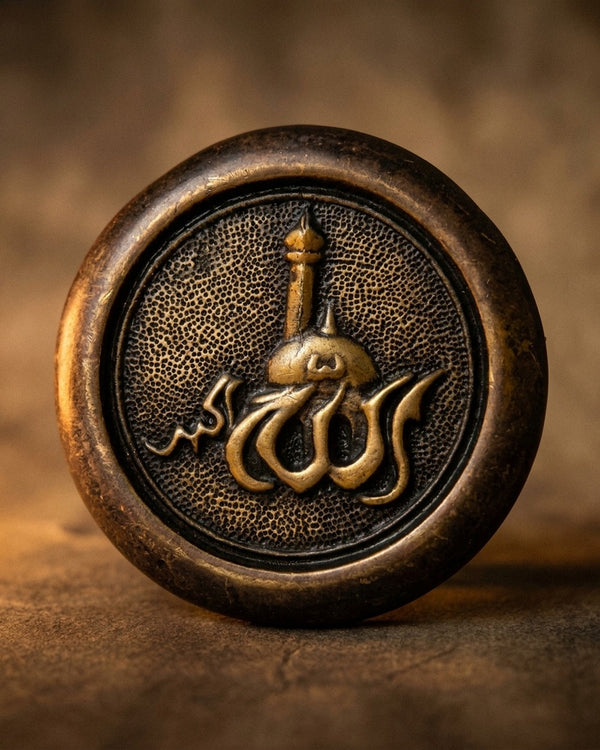
You do not need a large piece. A small worked plaque — calligraphy raised from the metal, the surface gone soft and dark — sets the whole register of a shelf.
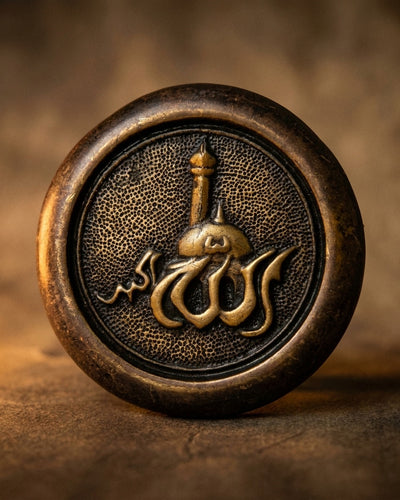
Hand-Worked Islamic Brass Plaque
a brass face that has gone quiet and dark with handling
This hand-worked plaque, with its raised Arabic calligraphy and a little minaret pressed into the brass, is exactly the kind of object that does the work: small, dark, catching the light along its high points. We are honest about what it is — an antique-style piece in the early-twentieth-century Islamic manner, whose exact age we cannot document — so we sell it for its face, not its paperwork. Leant against a wall or hung in a quiet corner, it is a single struck note of the souk.
How do you use enamel colour without it feeling like a costume?
This is where most "Moroccan" rooms go wrong: they turn the colour up everywhere and the room starts to look like a theme restaurant. The fix is restraint. Let the walls and the larger furniture stay quiet and earthy, then add jewel colour in one or two small, concentrated objects — a box, a glass, a tile. The eye reads it as richness, not as fancy dress.
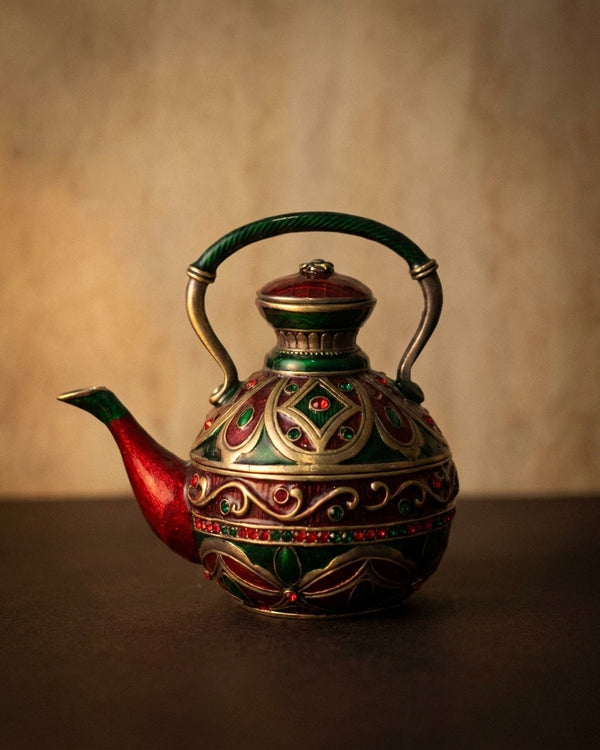
A little enamelled vessel is the perfect dose: small enough to be a detail, vivid enough to carry the whole mood.
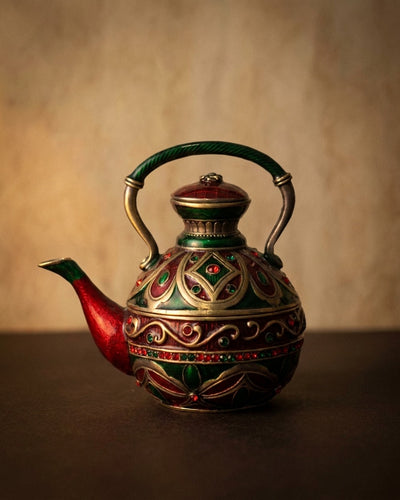
Cloisonné Teapot Keepsake Box
a little teapot that keeps secrets instead of tea
This teapot-shaped keepsake box does exactly that job — cloisonné enamel in jewel red and green with gold scrollwork, loud in the unembarrassed way the old Orientalist taste was loud. It was never meant to pour; lift the hinged lid and it keeps rings, coins, the small things you do not want to lose. It is new, made today in that old taste — vintage in style, not an antique — and on a dressing table or a hallway dish it is a single flash of bazaar colour against a plain morning.
Three moves to build the feeling
You do not need to rebuild a riad. You need three moves:
- Lower and warm the light. One shaded amber lamp does more than ten bright bulbs. The souk is a place of shade pierced by warm light.
- Add one piece of aged brass. Let it be the thing the light lands on. Dimmed, not polished.
- Add one small hit of jewel-toned enamel or glass — and then stop. The restraint is what keeps it from becoming a costume.
The point was never to own the souk. It is to keep one or two honest objects that carry its warmth — and to let a quiet room suggest a place far older and further away than the one you are standing in.